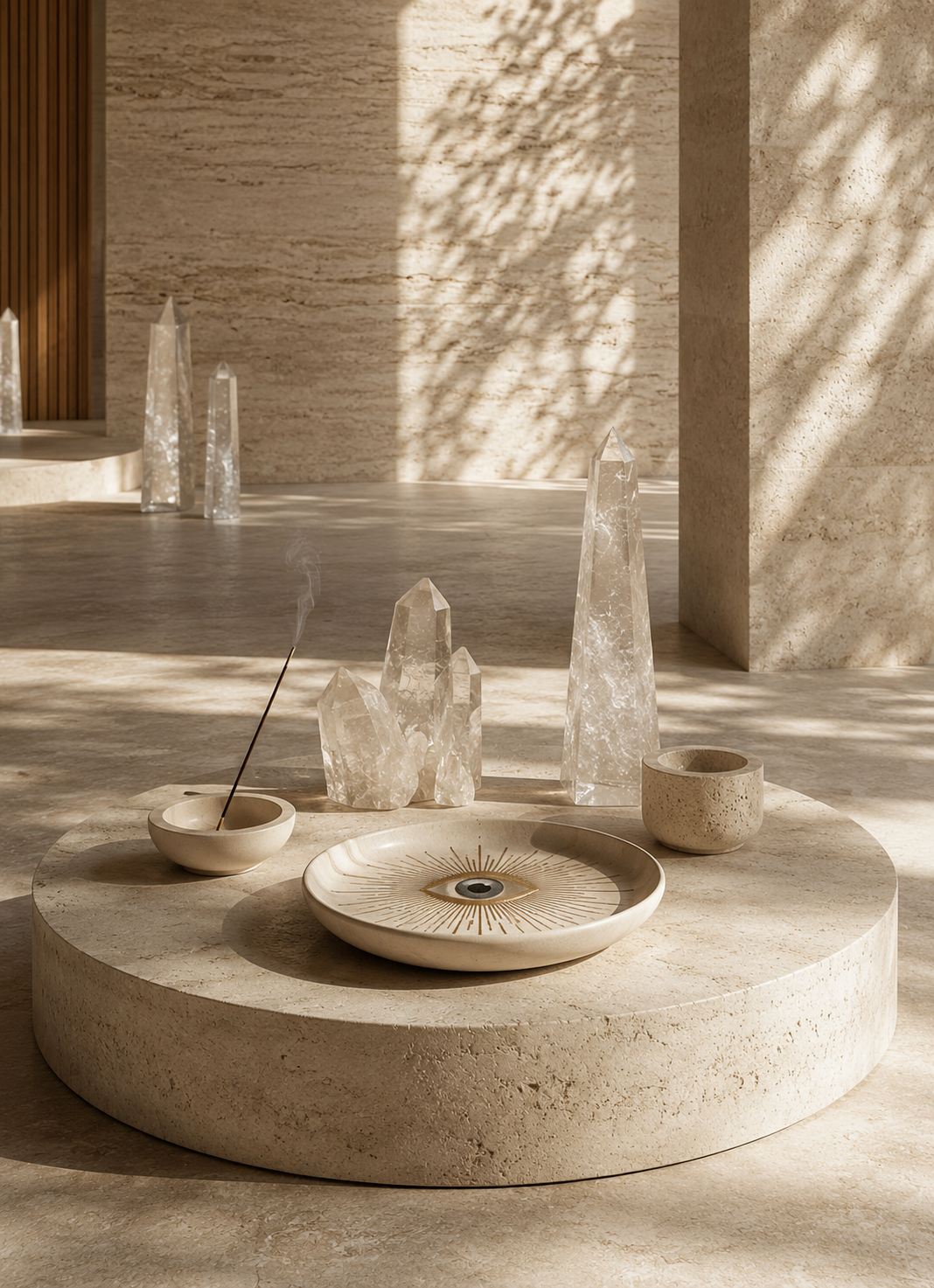
What Is the Evil Eye? The Ancient Symbol in Modern Minimalist Living
Picture a quiet afternoon at home. Light filters through the window and casts soft shadows across the room. On a stone tray near the entryway sits a small, familiar motif: an eye.
You have probably seen the Evil Eye on jewelry, keychains, ceramics, wall hangings, and small objects kept near a doorway. It is often recognized by a blue-and-white eye-shaped bead, but the idea behind it is older and more varied than that single design.
The Evil Eye is a traditional belief in the power of an envious or harmful gaze to bring misfortune, while protective amulets associated with the belief are meant to guard against that gaze. The belief and the amulet are related, but they are not exactly the same thing. Across different cultures and periods, people have used many forms of protective objects—not only the familiar blue eye.
Today, some people continue to understand the Evil Eye through religion, family tradition, or cultural practice. Others wear or display the symbol as a personal reminder of protection, boundaries, and the kind of energy they want to keep close. It can hold meaning without needing to be treated as a scientifically proven shield.
What Is the Evil Eye?
The phrase “evil eye” traditionally refers to a harmful gaze, often connected with envy, jealousy, admiration, or ill intention. In many traditions, that gaze was believed to cause bad luck, illness, or other forms of misfortune.
The protective object is something different: an amulet or symbol worn, carried, or placed in a space to help ward off the evil eye. This distinction matters because modern design often uses the eye-shaped amulet itself as shorthand for “the Evil Eye,” even though historically the feared gaze and the object intended to protect against it are two separate ideas.
That also means there is no single universal Evil Eye symbol. Eye motifs are one important form, but protective traditions have also used hands, beads, stones, inscriptions, mirrors, colors, and other amulets. Meanings and practices can differ significantly from one community to another.
A Protective Idea With Many Cultural Histories
The Evil Eye is sometimes presented online as though it came from one place, one religion, or one neatly defined ancient story. Its history is more complicated. Beliefs about harmful or envious gazes have appeared across the Mediterranean, the Middle East, North Africa, the Balkans, South Asia, and other regions, with different communities developing their own protective customs and objects.
Eye-shaped amulets themselves also have long histories. Ancient Egyptian wedjat eye amulets, for example, were associated with protection, healing, and regeneration. Elsewhere, protective objects against the evil eye have taken very different forms. The common thread is not one standardized design but the human desire to protect what is valued from envy, danger, or unwanted attention.
This is why it is useful to approach the symbol with a little context. A modern blue glass eye may be familiar around the world, but it should not be treated as the only “authentic” version of the tradition. Cultural meaning lives in the practices around an object as much as in its shape.
Why Is the Evil Eye Usually Blue?
The blue-and-white concentric eye is one of the most recognizable modern forms of Evil Eye amulet, particularly in Turkish visual culture and across parts of the Mediterranean and neighboring regions. Its popularity has made blue feel almost inseparable from the symbol in contemporary fashion and decor.
But blue is not a universal requirement, and color meanings are not identical across every tradition. You will find protective amulets in many materials and colors, from glass and metal to stone, textile, and ceramic.
For modern use, it is better to think of color as part of the object’s cultural history and design rather than assigning rigid promises to every shade. A cobalt-blue eye can feel traditional and graphic; a neutral ceramic interpretation may sit more quietly in a minimalist room. The symbolism can remain recognizable even when the design language changes.
Why the Symbol Still Resonates Today
We live in a very different world from the people who first carried protective amulets, but the emotional themes behind the Evil Eye are easy to recognize: envy, visibility, comparison, attention, and the wish to protect what matters.
Social media has made those themes especially familiar. We see more of other people’s lives, and more people can see ours. That does not mean a passive-aggressive comment or an Instagram scroll is literally an “evil eye.” But the old symbolism can offer a surprisingly modern reminder: not every opinion deserves access to your inner world.
For someone who connects with the tradition, wearing or displaying the symbol may carry spiritual or cultural meaning. For someone approaching it more personally, it can act as a visual anchor for boundaries—pause before absorbing someone else’s mood, notice when comparison is taking over, or remember that privacy can be a form of care.
The value does not have to come from fear. It can come from attention.

Wearing the Evil Eye in Everyday Life
Jewelry is one of the easiest ways to keep the motif close because it can become part of an ordinary routine rather than something reserved for a special ritual. A small pendant, bracelet, or pair of earrings can be visually subtle while still carrying personal meaning.
The most wearable version is usually the one that fits naturally with what you already own. Some people prefer classic blue glass or enamel because it feels connected to the familiar protective motif. Others gravitate toward gold, silver, shell, ceramic, or more minimal interpretations.
If you are choosing a piece for its symbolism, start with the meaning rather than trying to assemble a complicated set of “energies.” Ask whether the object reminds you of protection, steadiness, family, faith, or a boundary you are trying to keep.
Auratract’s Evil Eye collection brings the motif into understated jewelry and small home pieces designed to feel easy to live with rather than overly ceremonial.
If you also wear crystal jewelry, there is no universal rule saying the two cannot be combined. Our guide to wearing the Evil Eye and crystals together looks specifically at how their symbolic meanings can sit alongside one another without turning every combination into a fixed formula.

Bringing the Evil Eye Into a Minimalist Home
A protective symbol does not have to dominate a room. In a calm, natural interior, one small object can be enough to create a point of meaning without adding visual clutter.
The entryway is a popular place for an Evil Eye because it is the threshold between the outside world and home. If that placement feels meaningful to you, a small dish, hanging piece, or object on a console can become a cue to leave part of the day at the door. It is better to think of this as symbolic placement than as a universally required or “most effective” location.
A desk can make sense if the symbol reminds you to protect your attention while working. A bedside table may feel more personal. On a shelf, it can sit among books, ceramics, or objects collected over time rather than becoming a separate spiritual display.
This approach fits naturally with a minimalist or Wabi-Sabi-inspired home: fewer objects, but more intention behind the ones you keep. If you are building a quieter corner rather than a formal altar, our Mindful Home collection focuses on small objects that support a calmer, more considered space.
Can an Evil Eye Protect Your Home’s Energy?
In traditional belief, protective amulets are used to ward off the evil eye. In a modern home, people may continue that practice spiritually, culturally, or symbolically. What the object should not be presented as is a scientifically proven device that removes negative energy or guarantees protection from other people.
If the symbol helps you remember to set boundaries, reset a crowded entryway, close the laptop at the end of the day, or choose what you allow into your attention, that is already a meaningful role.
For a broader look at the difference between cleansing a space and maintaining the feeling afterward, our guide to cleansing and protecting a heavy-feeling home explores both practical habits and symbolic protection.
Respecting the Meaning While Making It Your Own
There is a difference between adapting a symbol to your home and stripping it of all context. The Evil Eye has living cultural, religious, and family meanings for many people. A minimalist interpretation does not erase that history.
You do not need to imitate a tradition that is not yours or claim powers you do not believe in. You can learn what the symbol means, understand that practices vary, and choose a piece because its message of protection or boundaries genuinely resonates with you.
That is a more thoughtful way to bring an old symbol into a modern life: not as a trend emptied of meaning, and not as a promise that one object can control what happens around you, but as something you notice and return to.
A Gentle Anchor
There is something compelling about a symbol that looks outward while asking you to care for what is inward.
The Evil Eye has endured because ideas about envy, attention, protection, and vulnerability are deeply human. Those ideas have been expressed differently across cultures and centuries, and they continue to change as the symbol moves through jewelry, interiors, fashion, and everyday objects.
Whether the motif is part of your cultural tradition, a spiritual practice, or simply a meaningful reminder, it does not need to carry the weight of doing everything for you. Let it mark the boundary. Let your habits, choices, and relationships do the rest.
FAQ About the Evil Eye
What is the Evil Eye?
The Evil Eye is a traditional belief in the power of an envious or harmful gaze to bring misfortune. Protective amulets associated with the belief are worn, carried, or displayed to ward off that gaze. The belief itself and the protective eye-shaped symbol are related but are not exactly the same thing.
Is the Evil Eye symbol the same as the Evil Eye belief?
No. Traditionally, the “evil eye” refers to the harmful gaze. The eye-shaped bead or other protective amulet is intended to guard against it. Modern language often uses “Evil Eye” for both, which is why the distinction can become blurred.
What does the blue Evil Eye mean?
Blue-and-white eye beads are one of the most recognizable forms of protective amulet today, but blue is not a universal requirement and color meanings vary by tradition. It is better to understand the blue eye as one culturally familiar form rather than assigning a guaranteed effect to the color itself.
Where should you place an Evil Eye in your home?
There is no single required placement across all traditions. Entryways are a popular modern choice because they symbolically mark the threshold of the home, but a desk, shelf, or bedside table can also make sense when the object has personal meaning there.
Can you wear the Evil Eye and crystals together?
Yes. There is no universal rule preventing the two from being worn together. If both are meaningful to you, think of their associations as complementary symbols rather than a fixed formula or guaranteed energetic effect.